Rejuran for Fine Lines

Drs. Tom van Eijk
Rejuran may make some superficial fine lines less noticeable when changes in skin quality contribute to their appearance. The expected effect is usually gradual and different from directly filling a line or reducing the muscle movement that creates it.
The most important question is therefore not simply where the line is, but why it is visible. A superficial line that remains visible while your face is relaxed raises a different treatment question from a line caused mainly by facial expression, a deep skin fold or a change in underlying facial volume.
A practitioner can assess the line, surrounding skin and your treatment goal before discussing whether Rejuran is a reasonable option.
Compare Rejuran clinics near you
Compare on experience & price Make an appointment immediately
Does Rejuran help fine lines?
Rejuran may help make some superficial fine lines less noticeable when skin quality is an important part of why the line is visible. It is an injectable treatment based on polynucleotides, often shortened to PN, and is used with the aim of influencing characteristics of the skin rather than directly filling a wrinkle.
Clinical research into injectable polynucleotides has reported possible changes in measures such as wrinkles, skin texture and elasticity. However, the available evidence remains limited compared with some longer-established aesthetic treatments, and studies differ in the products, treatment areas and protocols examined.
This means Rejuran should not be presented as a guaranteed treatment for every fine line.
For a broader explanation of the treatment itself, see the main Rejuran guide.
Which fine lines may be more relevant to Rejuran?
Fine lines that remain visible when your face is relaxed may be more relevant to a skin-quality treatment than lines that appear almost entirely during facial movement.
The depth of the line also matters. A very superficial line within the skin is different from a deeper crease or fold involving changes in the tissues underneath it.
During an assessment, useful questions include:
Is the line visible when the face is completely relaxed?
Does it become much stronger when you smile, squint or frown?
Is it a superficial line or a deeper fold?
Does the surrounding skin look thin, crepey or texturally different?
Is loss of underlying facial volume contributing to the crease?
More than one factor can be present at the same time. A line does not have to fit neatly into one category.
Fine-line patterns and what they may mean
Superficial lines visible at rest
A line that remains visible while your facial muscles are relaxed may partly reflect changes within the skin itself.
That does not automatically mean Rejuran is appropriate. A practitioner should still assess the depth of the line, surrounding skin and other anatomical factors before discussing treatment.
Thin or crepey-looking skin
Fine surface lines can appear more noticeable where the skin looks thin or crepey.
Rejuran is used with the aim of affecting skin quality rather than creating structural volume. Whether that treatment goal is relevant depends on what is contributing most to the appearance of the area.
Fine lines around the eyes
The eye area can contain several different types of lines. Some remain visible at rest, while others appear mainly when smiling or squinting.
The thin skin in this area also requires specific assessment. See the dedicated guide to Rejuran under the eyes for treatment-area information.
Lines that mainly appear with facial expression
A line that appears mainly when you smile, squint or frown has a strong movement-related component.
Rejuran does not reduce the muscle activity producing that movement. Improving skin quality alone may therefore not address the main reason the line appears.
Static vs dynamic fine lines: what is the difference?
A static line remains visible when your face is relaxed. A dynamic line develops or becomes more obvious when facial muscles move.
Some lines have both characteristics.
For example, a line beside the eye may be faintly visible at rest but deepen substantially when you smile. In that situation, both skin characteristics and movement may contribute.
This distinction matters because Rejuran does not reduce muscle activity. Its treatment goal is therefore different from treatments specifically intended to influence movement.
The categories are useful for understanding a line, but they should not be used to diagnose yourself or choose a procedure without an assessment.
When might Rejuran be less suitable for fine lines?
Rejuran does not address every reason a wrinkle or crease becomes visible. The line's depth, movement and underlying anatomy all matter.
When the line is mainly caused by movement
If a line largely disappears while your face is relaxed and appears mainly when you smile, frown or squint, facial movement is likely to be an important factor.
Rejuran does not directly reduce that movement.
When the line is a deeper fold
A clearly established crease or deep skin fold is different from a superficial fine line.
Rejuran should not be described as a treatment that directly fills a deep fold or guarantees that it will disappear.
When underlying volume contributes
Changes beneath the skin can make some folds or creases more noticeable.
Rejuran is not intended to restore structural facial volume in the same way as a conventional dermal filler. If this distinction is relevant to your decision, see Rejuran vs fillers.
When you want an immediate wrinkle-filling effect
Rejuran is not a direct wrinkle filler. Any visible skin changes are generally assessed over time rather than immediately after the injections.
If your main priority is an immediate structural change, discuss that expectation clearly during your consultation.
Choosing not to have treatment is also a valid option.
What affects whether Rejuran fits a fine line?
Is the line visible when your face is relaxed?
A superficial line that remains visible at rest may have a stronger skin-quality component than a line that only appears during movement.
A practitioner can assess how much of the line remains visible without facial expression.
How much does movement affect the line?
Ask what happens when your face moves normally.
If smiling, squinting or frowning creates most of the visible line, treating skin quality alone may not address its main cause.
How deep is the line?
A fine line within the superficial skin is not the same as a deeper crease involving the tissues underneath.
This is one reason photographs alone cannot reliably establish which treatment, if any, is appropriate.
What role does skin quality play?
Rejuran contains polynucleotides and is used with the aim of influencing skin quality. The exact biological claims made about PN treatments should remain proportionate to the available evidence.
For a more detailed explanation of the ingredient and treatment category, see Rejuran polynucleotides.
What does research tell us about Rejuran and fine lines?
Research into injectable polynucleotides has reported possible improvements in measurements relating to wrinkles, skin texture and elasticity. The eye area is represented in some of the available clinical research.
The evidence should still be interpreted cautiously.
Studies vary in the PN product used, treatment protocol, injection area, participant group and method used to assess change. The total evidence base is also relatively small.
Results from one study therefore cannot be assumed to predict what every person will experience or what every Rejuran product will achieve in every treatment area.
A useful way to interpret the research is:
it suggests that improvement may be possible, but it does not make an individual result predictable.
Claims about collagen should be approached with the same caution. See the dedicated explanation of Rejuran and collagen stimulation if you want to explore that mechanism separately.
When can you assess Rejuran results for fine lines?
Do not judge the result immediately after the injections.
Temporary swelling, redness or small raised injection points can change how the skin looks shortly after treatment. These early changes do not show whether a fine line will ultimately become less noticeable.
Any change in skin texture or superficial lines may develop gradually. The most useful comparison is therefore made at the review point agreed as part of your treatment plan.
When reviewing photographs, compare:
the same treatment area;
similar lighting;
the same facial angle;
a relaxed facial expression;
normal facial movement;
overall skin texture as well as one individual line.
How long an eventual effect remains visible is a separate question. See how long Rejuran lasts for the dedicated longevity guide.
Rejuran before and after
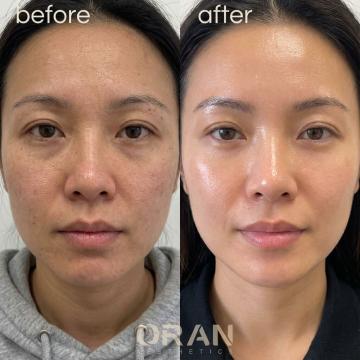
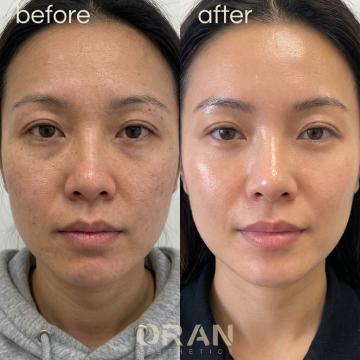
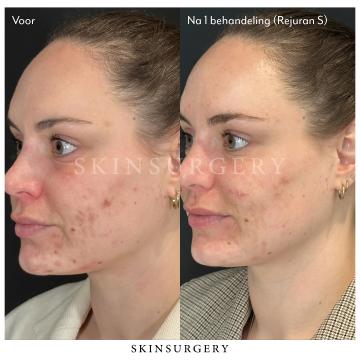
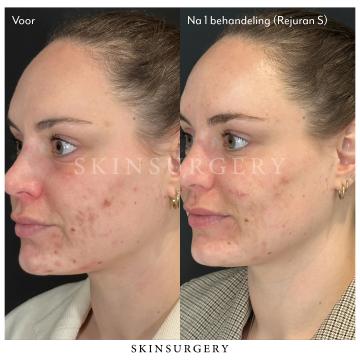
How to assess changes in fine lines
- 1 Take baseline photos in neutral, consistent lighting
- 2 Use the same angle and similar camera distance later
- 3 Compare your face both relaxed and during normal expression
- 4 Look at the whole treated area, not just one line
- 5 Wait until the agreed review point before judging the result
- 6 Discuss what changed and what did not with your practitioner
What if you see little or no difference?
Seeing little change does not automatically prove that the treatment has failed, but it is a reason to review what was originally being treated and how the result was supposed to be assessed.
Useful questions include:
Has enough time passed for the agreed review?
Was the main goal skin texture, one fine line or the whole treatment area?
Was the line mainly related to skin quality in the first place?
Is the comparison being made under similar lighting and facial expression?
Has there been any measurable change, even if it is subtler than expected?
Do not assume automatically that another treatment is required.
The next step should be to reassess what has changed, what has not and whether the original treatment goal remains appropriate. See what to consider when Rejuran appears not to be working.
Rejuran side effects and recovery: what should you know?
Rejuran is an injectable treatment, so temporary reactions can occur around the injection sites.
These may include redness, swelling, tenderness, bruising or small raised areas shortly after treatment. What you personally experience can vary by treatment area and technique.
Injectable treatments are not risk-free. Before treatment, ask what reactions are expected, what aftercare is advised and how to contact the clinic if something does not develop as expected.
Seek advice from the treating clinic or an appropriate medical professional if symptoms are severe, unexpected or becoming progressively worse.
For a fuller safety explanation, see Rejuran side effects.
What does Rejuran for fine lines cost?
The amount charged for Rejuran can vary between clinics and treatment plans.
When comparing a quoted price, check what it actually includes. Relevant factors can include:
the Rejuran product being used;
the treatment area;
the amount or product configuration involved;
whether the price is for one appointment or a wider treatment plan;
consultation arrangements;
follow-up arrangements.
A lower displayed price does not by itself show which treatment plan is more appropriate for a particular fine line.
For dedicated UK pricing information, see Rejuran costs.
| Treatment | Unit | City/country | Price | |
|---|---|---|---|---|
| Rejuran | per treatment | United Kingdom | £ 140 | Lowest price |
| Rejuran | per treatment | United Kingdom | £ 268 | Average price |
| Rejuran | per treatment | United Kingdom | £ 400 | Highest price |
How do you compare clinics for Rejuran and fine lines?
A useful Rejuran consultation should involve more than confirming that you have a visible line.
The practitioner should assess why the line is visible and explain why improving skin quality is, or is not, a logical treatment goal in your circumstances.
When comparing clinics, consider:
who carries out your consultation;
who performs the injections;
what relevant training and experience can be verified;
experience with Rejuran or comparable PN treatments;
experience treating the specific anatomical area;
which Rejuran product is proposed;
why that product and treatment approach are being suggested;
what degree of change is considered realistic;
which side effects and risks are discussed;
what happens if you are concerned after treatment;
whether follow-up is available;
whether you are given space to decide against treatment.
A professional title or registration, where relevant and verified, should not automatically be treated as proof of extensive experience with Rejuran.
See more questions to consider when choosing a practitioner for Rejuran.
Compare clinics in United Kingdom

- Rejuran from
- £ 295,00









Frequently asked questions about Rejuran and fine lines
Does Rejuran work for fine lines?
Rejuran may make some superficial fine lines less noticeable when skin quality contributes to their appearance. Results vary, and improvement cannot be guaranteed for every type of line.
Which fine lines may be most relevant to Rejuran?
Superficial lines that remain visible while your face is relaxed may align more closely with Rejuran's skin-quality treatment goal than lines caused mainly by facial movement. Depth and underlying anatomy also matter.
Can Rejuran remove fine lines completely?
No complete removal can be guaranteed. The realistic aim may be for some superficial lines to become less noticeable rather than disappear entirely.
Can Rejuran help lines that only appear when I smile?
Lines that appear mainly during smiling or squinting have a strong movement-related component. Rejuran does not reduce facial muscle activity, so improving skin quality may not address the main cause of the line.
Can Rejuran help crow's feet?
Some clinical research into polynucleotide injections has included wrinkles around the eyes. Crow's feet can contain both static and movement-related components, so a practitioner should assess what is contributing to the lines before discussing treatment.
How long does it take to see whether Rejuran has helped fine lines?
Do not assess the result immediately after injection because temporary swelling or raised injection points can change how the area looks. The appropriate review point depends on the treatment plan.
Is Rejuran better than anti-wrinkle injections for fine lines?
Not necessarily. They have different treatment goals. Rejuran is used with the aim of influencing skin quality, while botulinum toxin-based anti-wrinkle treatment targets muscle activity. Which approach, if any, is relevant depends on why the line is visible.
How long does recovery take after Rejuran?
Temporary injection-site reactions can occur and recovery varies between individuals and treatment areas. See the dedicated Rejuran recovery guide for more detail.
What is the difference between Rejuran and Profhilo?
Rejuran is based on polynucleotides, whereas Profhilo is based on hyaluronic acid. Their composition and treatment approach therefore differ. See the full Rejuran vs Profhilo comparison.